Your expert on destination Thailand
Wat Pha Lat is a quiet forest temple on the Doi Suthep road above Chiang Mai, reached by car or by the 30 to 45 minute Monk's Trail walk. It has a stream, mossy stairways and resident monks, and most visitors to Doi Suthep drive straight past it.

Chiang Mai has more than 300 temples, and most travellers see three of them: Wat Phra Singh, Wat Chedi Luang and, of course, Wat Phra That Doi Suthep at the top of the mountain. On the road up, about 6 km after the climb starts, sits one that far fewer people know. Wat Pha Lat, the "temple on the sloping rock", is in our eyes the most pleasant of all the temples in Chiang Mai. Not for its gilding or its grandeur, but for its atmosphere. The jungle reclaims the stone, a stream replaces the tourist din, and it's a temple you have to earn.
Wat Pha Lat is a forest temple on the Doi Suthep road. Entry is free, there is no ticket office, and a donation helps the resident monks.
It suffers from a cruel paradox. It sits on the way to the most visited attraction in the city, yet nearly everyone drives past in a hurry to reach the summit. The red songthaews, the shared taxis of Chiang Mai, climb the bends without a pause, and nothing from the road marks the temple except a sign like many others. That discretion explains why the place has kept its character. There are no souvenir sellers and no queues, just a few monks going about their business, and often nobody else, especially in the low season.
If you're building a trip to northern Thailand, this is the stop that makes the temple list feel less like a checklist.
The story of Wat Pha Lat is tied to Doi Suthep by a founding legend. In the 14th century, King Kuena of Chiang Mai received a sacred relic of the Buddha. To choose where the temple that would house it should stand, he placed the relic on a white elephant and let the animal wander into the jungle. It climbed the mountain, stopped to rest on a sloping rock, then went on to the summit, where it trumpeted three times. The king took this as an omen and ordered a temple built at the top.
The rock where the elephant paused is where Wat Pha Lat stands. That is the legend; history is a little more down to earth. Wat Pha Lat served as a resting stage for monks on their way up the mountain, long before the road existed. Work on the modern road began in 1934 and finished in 1935, and the temple's restoration started in 1934 too, paid for by a wealthy Burmese wood merchant.
Either way, it has always been a place to slow down before the climb.
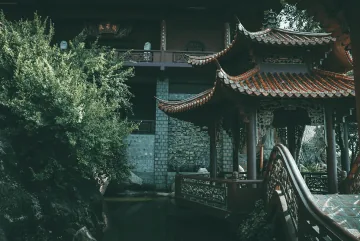
Forget the single hall inside an enclosure wall. Wat Pha Lat is a group of structures spread along the hillside and joined by stone paths, wooden bridges and moss-covered stairways. You don't visit it so much as get gradually lost in it, and come across hidden corners at every bend.
Here, a stone Buddha sits at the foot of an old tree. There, a golden stupa is half covered in vegetation, as if the forest were slowly taking it back. Further on, incense burns on a small altar guarded by nagas and elephant statues, weathered by time.
A stream cascades through the rocks and runs under the wooden bridges and around the statues. Its murmur follows you everywhere, with birdsong and the rustle of bamboo on top. After the rainy season, which ends in October or November, the stream turns into a small waterfall.
The canopy filters the sun into a golden half-light. Giant ferns cling to the rocks, moss covers every stone and lianas hang from the high branches. Now and then a ray of light lands on a Buddha or a chedi, and the effect is almost cinematic.
This is a working meditation temple, not a ruin. Several monks live here in small wooden huts scattered through the forest, and an open meditation hall welcomes practitioners, local and foreign.
The temple sometimes offers "monk chats": one-to-one conversations with a monk, where you can learn the basics of meditation and ask about Buddhism. They're informal and warm.
You don't need to meditate formally to feel the effect. Sit on a stone bench by the stream, close your eyes and listen for twenty minutes, and the calm arrives by itself. Chiang Mai, which you can see from above from the temple, feels a long way off.
Wat Pha Lat is about 6 km up the Doi Suthep road from the start of the climb. You can reach it by scooter, car or taxi, or on foot by the Monk's Trail, a 30 to 45 minute walk from behind the Chiang Mai University campus.
Not sure how to fit Wat Pha Lat into your days in northern Thailand? Our local experts can build it into a tailor-made route.
The Monk's Trail to Wat Pha Lat is about 2.4 km there and back. Most guides put the walk to the temple at 30 to 45 minutes one way.
The path starts behind the Chiang Mai University campus and climbs through forest where the trees are wrapped in orange monastic cloth. It was the main route up the mountain until the road opened in 1934, which is why it carries the name. Walking it is the most memorable way to arrive, and you reach the temple already in the right frame of mind. Pick your date with the best time to visit Thailand in mind, since a forest climb in the wet months is a different outing.
On the Doi Suthep road, look for a discreet sign on the left. It points to a path leading down to the car park. If you'd rather not drive the bends yourself, a taxi or Grab will take you to Wat Pha Lat if you name it. Don't count on a red songthaew: they don't stop at the temple.
Visit Wat Pha Lat first, then continue to Wat Phra That Doi Suthep. We recommend it in that order. The two temples are in very different styles, and the contrast heightens each of them: the forest silence first, the summit second.
Among the hundreds of temples in Chiang Mai, Wat Pha Lat reminds you why such places were built at all: as spaces of inner peace, not as attractions. If you'd like help planning Chiang Mai, Doi Suthep and the quieter corners around them, tell us what you enjoy and a local expert will design the trip with you. Our Thailand travel guide covers the rest of the country.
The full route from the university to Wat Phra That Doi Suthep is about 7.5 km, with roughly 620 m of climbing and around 3.5 hours of walking. Add time at both temples, a coffee stop and the way back, and set aside 4 to 6 hours for the whole outing.
Go early, between 8 and 10 am, when the light is soft, the air is cooler and fewer people are about. The temple is open every day. The dry season, from November to February, is the most comfortable time to walk up.
Allow 1 to 2 hours at a relaxed pace, because the shrines are spread along the hillside and linked by stairways and bridges. If you arrive on foot, the walk comes on top of that.
Subscribe and receive our travel inspirations and practical advice twice a month.

Wanting to share your trip with a group?