The Animals You'll Encounter in Mongolia
The animals you'll encounter in Mongolia
Mongolia, a vast land of steppes, mountains and deserts, offers a unique home to the wildlife that populates its landscapes. A trip to Mongolia is a chance to discover the diversity and richness of the animals that have always accompanied nomadic life and shaped the country's culture.
Horses
The horse is Mongolia's iconic animal. Its importance in Mongolian culture is such that more than 300 words exist to describe and categorise these historic companions of the nomads. However, the word 'pony' isn't among them. Despite their small size, that term would be an insult when describing Mongolian horses: sturdy, hardy and energetic, they are built for harsh winters and long journeys. With a population of nearly 4 million horses almost as many as there are people they shape the daily life of Mongolian families. The horse plays a central role in festivals, folk legends and spiritual practices: the traditional fiddle, the Morin Khuur, features a carved horse's head in homage to this revered animal. Deeply respected, it remains a symbol of freedom and belonging to the steppe.
You may also come across rarer subspecies such as the 'khulan', the Gobi's wild Asian ass, or the 'takhi', Przewalski's horse, the last true wild horse on the planet — successfully reintroduced into Mongolian nature reserves.
Eagles and birds
Travelling to the far reaches of the Altai brings you face to face with the Kazakh ethnic communities, famed trainers of golden eagles used for traditional hunting. A true emblem of this mountainous region, the eagle is far from alone in Mongolia, with the steppe eagle, the bearded vulture and the Altai vultures also present. There is also a rich diversity of birds of prey: falcons, buzzards, owls, as well as rare migratory species that stop off in Mongolia's steppe wetlands each spring and autumn.
Yaks
The Mongolian yak ('hainag' when crossed with cattle) thrives in the country's cold, mountainous regions. Essential to nomadic life for producing milk, dried meat (borts), wool and leather, there are close to 4.4 million head across the country. Its wool is prized for insulating yurts and making clothing. It accompanies families during seasonal migrations, withstanding the bitter winter cold.
Snow leopards and lynx
The snow leopard ('irbis') symbolises the wild, pristine nature of Mongolia's mountains. Very rare and protected, it is now threatened by poaching and shrinking habitat, with only a few thousand individuals left hidden in the Altai or Gobi Gurvan Saikhan National Park. Lucky travellers may spot the tracks of this elusive big cat. Its cousin, the lynx ('shiluus'), just as shy but more widespread, is found in the north, particularly around Lake Khövsgöl.
Camels
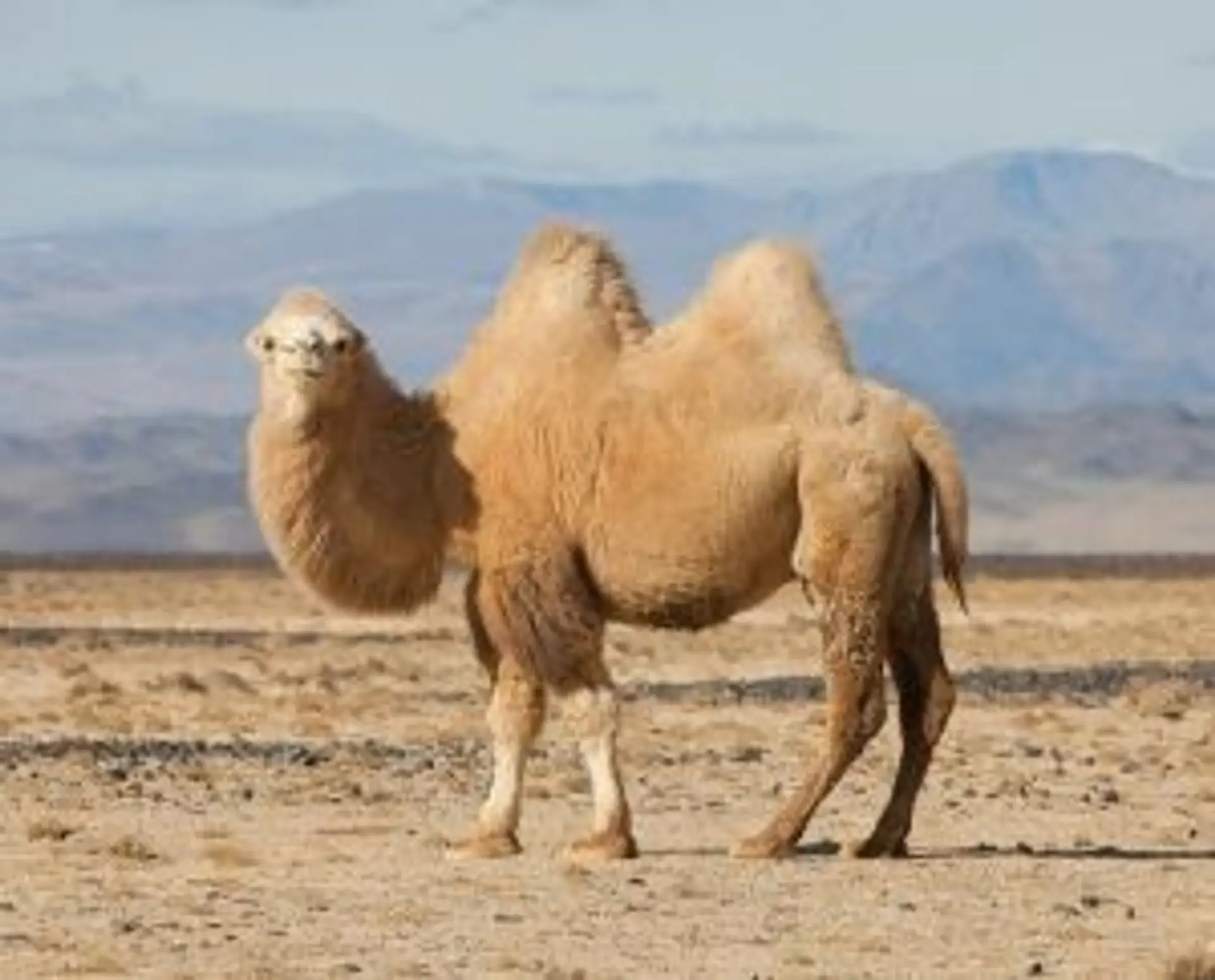
The two-humped Bactrian camel is king of the Gobi Desert, the region it originally comes from. Perfectly adapted to extreme conditions, it carries people and goods where neither horses nor modern vehicles can venture. Essential to nomadic mobility, camels are also celebrated at traditional festivals honouring their endurance and role in the local economy. There are close to 460,000 domesticated camels in Mongolia and several hundred still living wild in the most remote corners of the Gobi. Camel wool, warm and light, is also used to make clothing and blankets.
Bears
There are two bear species in Mongolia: the brown bear, found in the north, particularly near Lake Khövsgöl, and the Gobi bear ('mazaalai'), one of the rarest bears in the world and the only one to thrive in an arid desert environment. Only around thirty Gobi bears remain in the wild, making it the most endangered bear species on the planet. Conservation programmes are essential to the survival of this icon of the Mongolian deserts.
Ibex, argali sheep and goats
With more than 22 million goats ('gamaa') and 30 million sheep ('khon'), these domestic animals are at the heart of nomadic tradition. Sheep provide meat, milk and wool for making deels (traditional clothing) or felt for yurts, while goats are prized for their cashmere, considered among the finest in the world. On the wild side, there's the argali, an impressive wild sheep, and the Siberian ibex, found in rugged mountain ranges, notably in Altai and Gobi Gurvan Saikhan National Parks.
Wolves
The Mongolian wolf ('chono') both fascinates and frightens. Found throughout the country, it shares a special status with the horse in legend and mythology: the 'Blue Wolf', a celestial figure and mythical ancestor of Genghis Khan, holds a central place in Mongolian beliefs. In shamanic tradition, some see it as a spiritual guide, associated with strength and freedom. Despite its elusiveness, it occupies an important symbolic place in the collective imagination.
Deer and gazelles
Deer are abundant in Mongolia, though their distribution varies. The small Mongolian gazelle roams the eastern grasslands, while the goitered gazelle ranges across the semi-desert expanses of the Gobi, and the critically endangered saiga antelope inhabits the centre and west. Elk are also found in the northern forests, along with red deer and reindeer, the latter semi-domesticated by the Tsaatan people in the country's far north.
Small mammals and rodents
In Mongolia's grassy steppes, it's common to come across marmots with their distinctive whistle, as well as jerboas, gerbils and other rodents that play a vital role in the steppe ecosystem. Watching jerboas hop about at dusk is a fleeting but typical sight of these open landscapes.
Observing wildlife in Mongolia: practical tips
The best season for wildlife watching runs from May to September, with nature particularly vibrant in June. During this period, the steppes are lush, wildlife is active and the long days invite exploration. To make the most of your chances:
- Head to the Gobi region (especially Gobi Gurvan Saikhan National Park and Yolyn Am canyon), the Altai, or the forests around Lake Khövsgöl.
- Observing certain rare species, such as the snow leopard, is best done at dawn or dusk, accompanied by an experienced local guide.
- Keep a respectful distance, avoid causing any disturbance or excessive noise, and respect the animals' tranquillity.
- Certain species, such as the snow leopard, the Gobi bear or the saiga antelope, are strictly protected; approaching them closely or attempting to disturb them is prohibited under Mongolian law.
- Always check with professional guides and local authorities for any specific restrictions or guidance before wildlife excursions.
In summary:
| Aspect | Practical tips |
|---|---|
| Best season | May to September, June optimal |
| Recommended regions | Gobi (Gobi Gurvan Saikhan, Yolyn Am), Altai, Lake Khövsgöl |
| Respectful behaviour | Observe from a distance, don't feed or disturb the animals |
| Regulations | No close approach to endangered species, respect park rules |
Mongolia is home to an exceptional array of wildlife, a testament to the harmony between nature and nomadic tradition. On a tour, every animal encounter is a chance to better understand the country's rich culture and nature, always within a spirit of respect for this preserved environment.