Religion in Armenia
The main religion in Armenia is Christianity, practised through the Armenian Apostolic Church, which counted 97.5% of the population in the 2022 census. Armenia is known as the first country to adopt Christianity as its state religion, in 301. Smaller communities include Yazidis, Armenian Catholics, Protestants, Jews and Muslims.
Faith here is not a private matter kept behind church doors. It shapes the stone churches on hilltops, the calendar of feasts, and the way Armenians talk about their own history. This guide explains what the church believes in practice, which feasts you might catch, and which monasteries are worth building a trip around.
The main religion in Armenia
Almost everyone in Armenia belongs to one church. The 2022 census, as reported by the US State Department, puts the Armenian Apostolic Church at 97.5% of the population. The remaining 2.5% is made up of Catholics, Protestants, Yazidis, Muslims, Jews and others.
The church also has a place in law. The constitution, adopted in 1995 and amended in 2015, names the Armenian Apostolic Holy Church in Article 18 of the constitution and recognises its special role in the nation's spiritual life and history. In daily terms, that means being Armenian and being Apostolic are closely tied, even for people who rarely attend services.
Armenia, the first Christian nation
According to tradition, the apostles Bartholomew and Thaddeus first preached Christianity on Armenian soil in the 1st century. The date that counts is 301. That year Gregory the Illuminator converted King Tiridates IV, and the kingdom turned away from Zoroastrianism and older pagan beliefs to become the first state to adopt Christianity officially.
This matters far beyond history books. Armenia was later conquered, divided and scattered across the world, yet the church kept the language, the liturgy and the memory of the nation alive. Ask an Armenian why the church matters and you'll often hear that it held the people together when no state could.
The Armenian Apostolic Church
The Armenian Apostolic Church is an autonomous Oriental Orthodox church with its own hierarchy, liturgy and traditions. Since 1999 its head, the Catholicos of All Armenians, has been Karekin II, who sits at Etchmiadzin, a short drive from Yerevan.
How it differs from other churches
The church runs itself rather than answering to Rome or to another patriarchate. Services use classical Armenian (grabar) alongside modern Armenian, and the liturgy is solemn and slow, drawing on ancient rites of the East. Saints, martyrs and confessors hold an everyday place in prayer, and their relics and monasteries are major pilgrimage sites.
Religious feasts you can catch
The church year follows the great Christian feasts, and a few are easy to spot as a visitor.
- Armenian Christmas, 6 January: the Nativity and the Epiphany are celebrated together.
- Easter: marked by special foods and rituals at home and in church.
- Vardavar: a water festival linked to the Transfiguration, held 98 days after Easter. People throw water at each other in the streets, so wear something that dries fast. Details on Vardavar are easy to find, but the best way to understand it is to be soaked by a stranger's bucket.
Churches and monasteries to visit
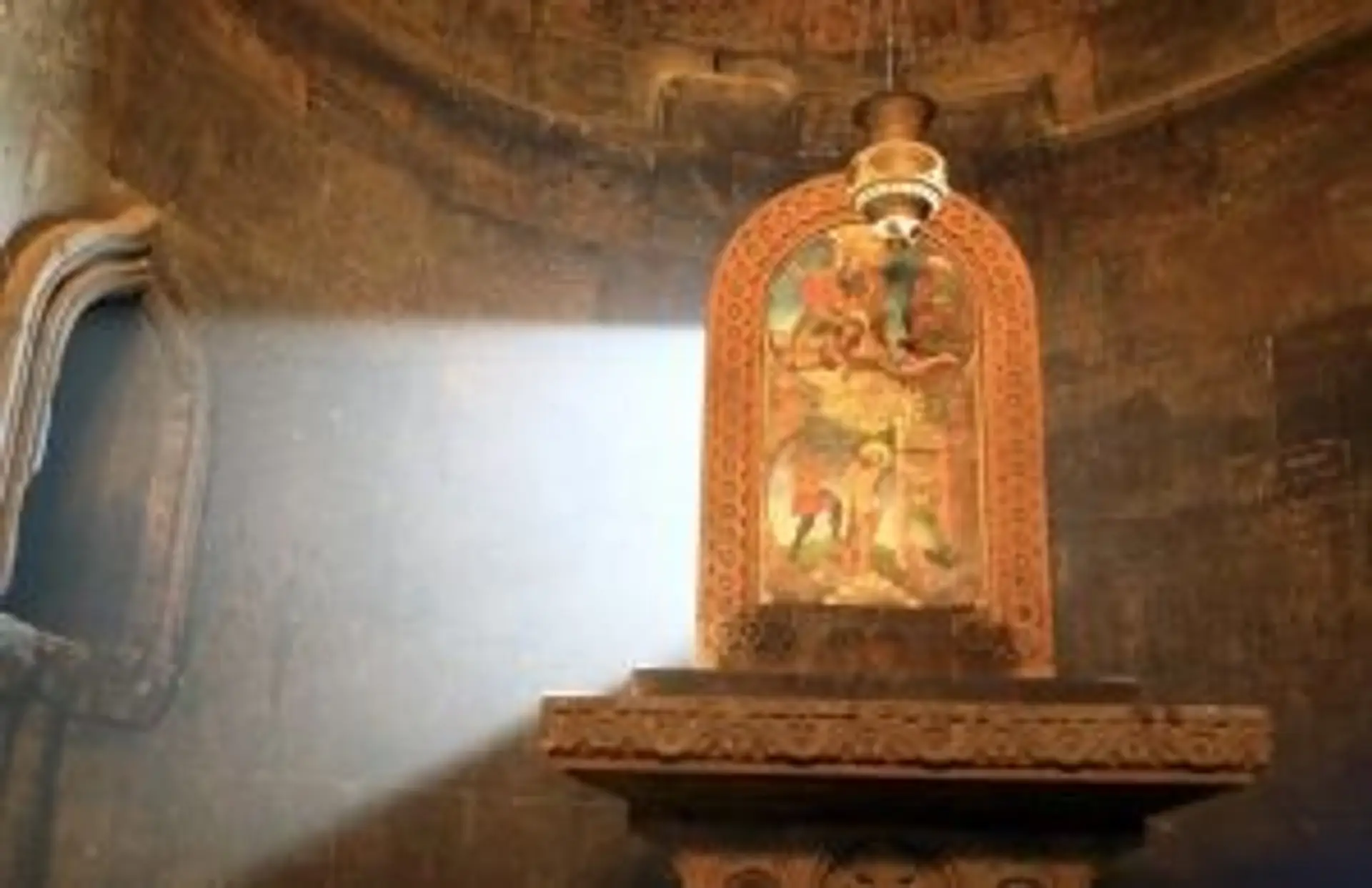
Armenian churches are instantly recognisable. Most follow a cruciform plan under a conical dome, built from volcanic tuff that turns pink, grey or almost black depending on the stone and the light. Outside, you'll see khachkars, upright stone crosses carved with lace-like patterns. Inside, the space is usually bare and dim, with a single shaft of light falling on the altar.
Four places show the range well:
- Etchmiadzin: the seat of the Catholicos. The cathedral and the ruined church of Zvartnots are inscribed as UNESCO World Heritage (2000).
- Khor Virap: a monastery on the plain, with Mount Ararat filling the view behind it on clear days.
- Geghard: a monastery partly cut into the rock of a gorge.
- Tatev: a monastery on the edge of a deep canyon in the south.
Our local experts can build a route through Etchmiadzin, Geghard and Tatev around your dates, as part of a trip to Armenia. Distances between them are long, so it helps to plan them across several days rather than squeeze them into one.
Other faiths in Armenia
Armenia is overwhelmingly Apostolic, but it isn't uniform. Other communities have lived here for generations, and they are part of the picture.
Catholics and Protestants
The Armenian Catholic Church is part of the Catholic Church and uses the Armenian rite with its own liturgy. The Protestant presence is smaller and goes back to missions in past centuries.
Yazidis
Most Yazidis in Armenia are Kurds whose families fled persecution in the late 19th and early 20th centuries. In 2019 a large Yazidi temple opened in Armenia, now their main place of worship.
Jews and Muslims
The Jewish community is old and today small. Muslims are few and live mostly in Yerevan, where the Blue Mosque is an active place of prayer. Islam came to Armenia through Kurds and Azeris.
Faith in daily life
Religion marks the big moments: weddings, baptisms and funerals usually involve the church, and many families still make pilgrimages to monasteries and holy sites. Feast days double as community gatherings, with food, music and a good deal of visiting between relatives. Coexistence between faiths is described as respectful, though national identity stays closely bound to the Apostolic Church.
If you plan to step inside churches and join local occasions, read our guide to culture and customs in Armenia first.
Tell us what you'd like to see and a local expert in Armenia will design your trip around monasteries, mountain villages and the feasts that fall during your dates.
Religion in Armenia FAQ
Yes. The Armenian Apostolic Church teaches that Christ is one person with one nature, fully divine and fully human. It did not accept the wording on Christ's two natures adopted at the Council of Chalcedon, which is why it stands apart from both Catholic and Eastern Orthodox churches.
Vardavar falls on Sunday 4 July 2027, as it always lands on a Sunday. In Yerevan the action centres on Republic Square, Swan Lake and the parks below the Cascade, mostly from about 10am to 3pm. Seal your phone in a waterproof pouch and leave documents at the hotel.
Stay indoors until the evening, which is the surest way. Cafes, restaurants and shops are generally off limits for splashing, so you can step inside for a break. Be careful on the street, though: water can also come down from balconies onto people walking below.