Your expert on destination Sri Lanka

Buddhism is the main religion in Sri Lanka, followed by about 70% of people, with Hindu (12.6%), Muslim (9.7%) and Christian (7.4%) communities alongside. Figures come from the 2012 census, as reported by the US State Department in 2023. Sri Lanka's religion shows in the landscape: dagobas, kovils, mosques and churches, and a calendar of processions.
Buddhism is the main religion in Sri Lanka: 70.2% of the population in the 2012 census, the most recent figure in the US State Department's 2023 report on international religious freedom. Article 9 of the constitution says the Republic "shall give to Buddhism the foremost place" (constitution text).
| Religion | Share of population (2012 census) |
|---|---|
| Buddhist | 70.2% |
| Hindu | 12.6% |
| Muslim | 9.7% |
| Christian | 7.4% |
Source: 2012 census, as reported by the US State Department (2023).
Other sources round these numbers or split them a little differently, so treat the decimals as approximate. The UK government's country policy note of February 2025 gives the same Hindu, Muslim and Christian shares. No newer census has been published with religion figures.
Sri Lanka follows the Theravada tradition, the orthodox form also practised in Thailand and Myanmar. It arrived in the 3rd century BCE through envoys of Emperor Ashoka, and took root when King Devanampiya Tissa converted.
Buddhism is closely tied to Sinhalese identity, though not exclusively: some coastal Sinhalese are Catholic, notably around Negombo. Its reach goes well past the temple. It touches daily life, schooling and politics, and appears even in national symbols.
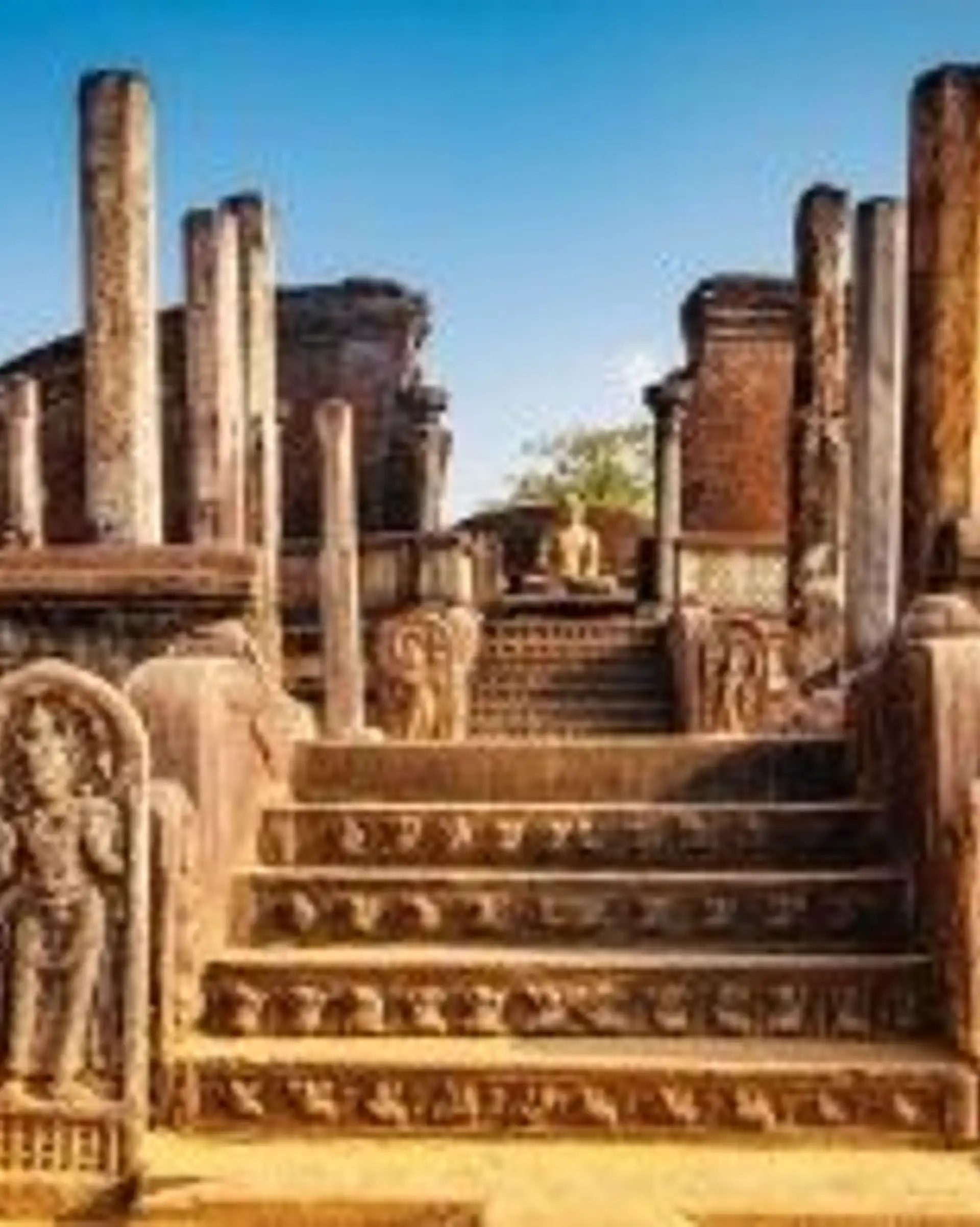
The ancient capitals Anuradhapura and Polonnaruwa hold the island's great ruins: huge dagobas (stupas), carved temples and rows of statues. The decorated caves of Dambulla add painted interiors. In Kandy, the Temple of the Tooth is where a relic of the Buddha is said to be kept.
Buddhist architecture here is easy to recognise from a distance: a white dome, often with a gilded spire, rising above the trees. Inside, expect quiet, flowers laid on altars and a lot of reclining and seated Buddhas.
If you would rather see these places in one route than piece them together, take a look at our Sri Lanka trip ideas.
Every full-moon day is a poya day, a public holiday with its own rituals. Three festivals stand out:
Dates move with the lunar calendar, so check the festivals of Sri Lanka page before fixing travel dates.
Hindus make up 12.6% of the population, mostly Tamils in the north, the east and the central plantation regions. The tradition is South Indian in origin and has a long history on the island. Worship centres on Shiva, his sons Ganesha and Murugan (also called Skanda), and the wider Hindu pantheon.
Kovils, the Hindu temples, are easy to spot: bright colours and crowded, exuberant sculpture. The Nallur Kandaswamy Kovil in Jaffna is regarded as a spiritual centre, and other important ones stand in Trincomalee, Nuwara Eliya and Haputale.
The Hindu calendar sets the rhythm of Tamil life:
The processions at Kataragama are the most intense. Fire walking, trances and colourful offerings turn them into some of the most striking rituals on the island.
Muslims account for 9.7% of the population. Most belong to the Moor communities, descended from Arab merchants who settled as early as the 8th century. The rest are Malays, who came during the Dutch period, and Indo-Pakistanis. The faithful are mostly Sunni.
Communities are spread across the island, with lively ones in Colombo, Puttalam, Beruwala, Batticaloa and around Kandy. Ornate mosques stand in towns and countryside alike. The Kachimalai mosque in Beruwala is described as the oldest and marks the arrival of the first Arabs. In Colombo, the red-and-white facade of the Jamiul Alfar Mosque, built in 1908 in the Pettah bazaar, is one of the best-known in the capital.
Practice follows the five pillars: the profession of faith, prayer, almsgiving, fasting in Ramadan and pilgrimage. The year is marked by Eid al-Fitr, the Festival of Sacrifice and Mawlid, which commemorates the Prophet's birth.
Christians are 7.4% of the population, a large majority of them Catholic, with Protestants and evangelicals making up the rest. Each colonial power left its own branch. The Portuguese brought Catholicism in the 16th century, the Dutch added Calvinism, and the British brought Anglicanism and evangelical churches. The history of Sri Lanka page covers these layers in order.
Negombo, nicknamed "Little Rome", remains the heart of Sri Lankan Catholicism. Christian communities also include the Burghers, descendants of Europeans, and some plantation Tamils.
Colonial churches, Protestant and Catholic, stand in Colombo, Galle, Negombo and Mannar. Near Mannar, the church of Our Lady of Madhu is a well-known pilgrimage site and gathers thousands of worshippers for the Assumption on 15 August.
The island's heritage is built from all four faiths. Buddhist and Hindu temples stand out for their grandeur and ornament, from the stupas of Anuradhapura and Polonnaruwa to the kovils of Jaffna and Trincomalee. Colonial churches and old mosques line the coasts, a record of successive waves of foreign influence. Each tradition fills the calendar with processions, dances and lights.
Adam's Peak is a major pilgrimage site revered by all the main religions. Elsewhere the overlap is quieter: Hindu statues stand in Buddhist temples, and in many homes the Buddha sits beside Jesus or Ganesha.
Interreligious dialogue has grown in recent years, despite the weight of history and political ups and downs. Symposiums, local committees and civil organisations work on mutual understanding between communities, notably in the East, North and Central regions. The Catholic Church takes an active part, even when the authorities' commitment is uneven. Coexistence here is sustained rather than settled, and it depends on culture and civil society.
To see how the communities fit together, read the guides to Sri Lanka's history and its languages.
Religion is part of everyday life, so a respectful attitude counts in any place of worship. At Buddhist temples, take off your shoes and headgear, and cover your shoulders, arms and legs. Stay calm and discreet, and skip public displays of affection in sacred places.
Our Sri Lanka culture guide sets out the wider etiquette, from greetings to gestures.
A route can follow the faiths: Buddhist Kandy, Hindu Jaffna, Catholic Negombo and the mosques of Beruwala. Our local experts can build it around the festival dates that matter to you. Send a trip request and they will shape the itinerary with you.
On paper, yes. Article 10 of the constitution says every person is entitled to freedom of thought, conscience and religion, including the freedom to adopt a religion of their choice. It also protects the right to practise and teach a faith, in public or in private.
Cover your shoulders, arms and legs at a kovil. Men may be asked to bare their chest inside some Hindu temples, so follow what worshippers do. Mosques can apply access and dress rules to women, so ask at the entrance before going in.
Do not pose for a photo with a Buddha statue, and do not touch statues or sacred monuments or point your feet at them. Owning or displaying objects decorated with the Buddha image, such as jewellery or tattoos, is forbidden and can bring severe penalties, so leave those souvenirs on the shelf.
Subscribe and receive our travel inspirations and practical advice twice a month.
Wanting to share your trip with a group?