Your expert on destination Indonesia
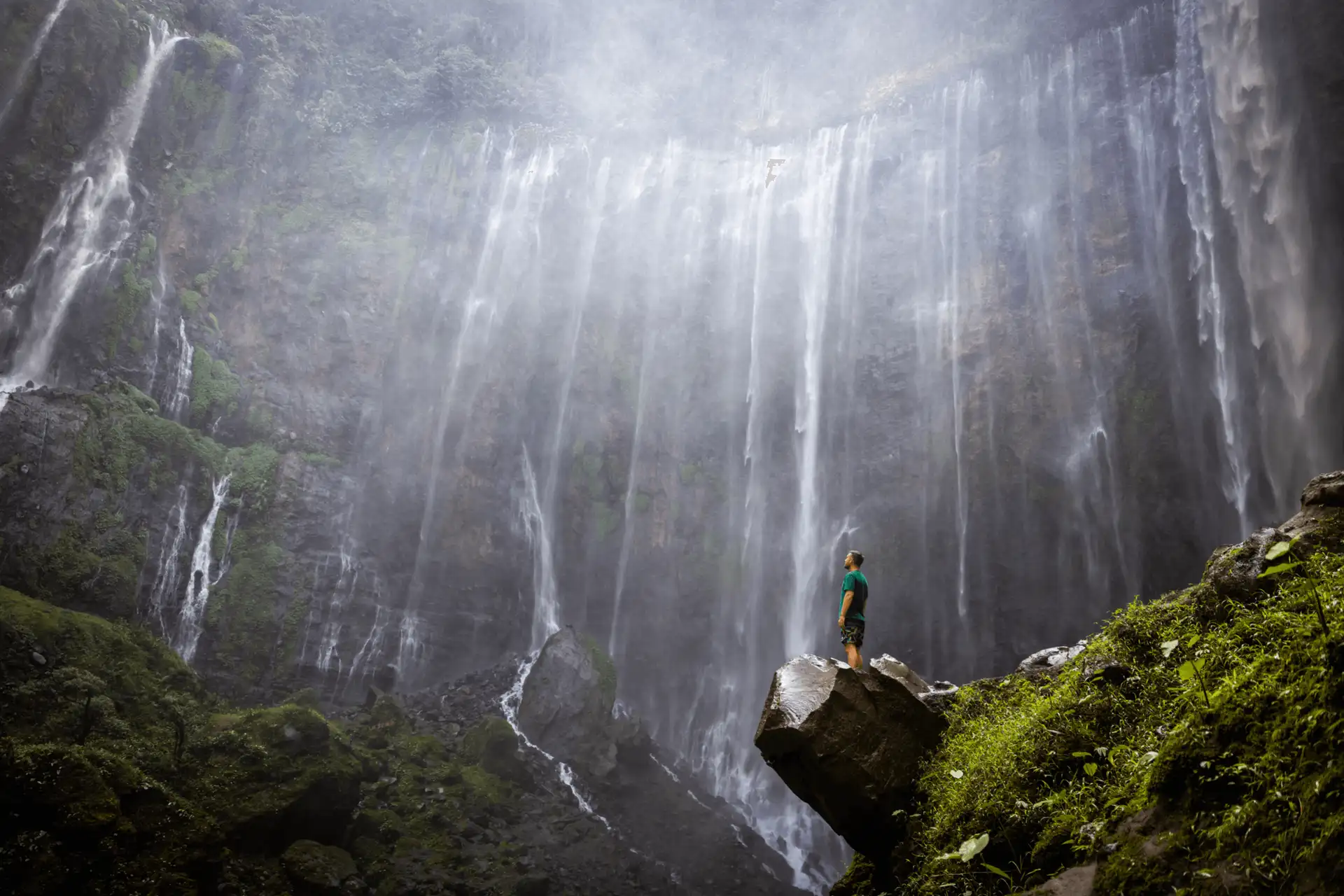
Tumpak Sewu waterfall in Lumajang, East Java, is a 120 m curtain of more than 30 separate falls spilling from a semicircular cliff, roughly twice the height of Niagara Falls. Yes, it is worth visiting: the viewpoint is a 10-minute walk from the car park, and the optional hike to its foot takes about 30 to 45 minutes down. Entry is around IDR 50,000 (about USD 3) as of April 2026, and the site is open 07:00 to 15:00. Allow about 3 hours for the full visit. Bring water shoes, because you will wade a knee-deep river. From the car park, a paved path crosses the jungle for about ten minutes. You pass a few stalls where local vendors sell snacks and drinks. Then the trees stop, a clearing opens, and the whole wall of water is in front of you.
As of April 2026, entry to Tumpak Sewu costs IDR 25,000-50,000 per person and the site is open 07:00 to 15:00. The main entrance charges about IDR 50,000. Carry rupiah in small notes, because prices change and card machines are rare.
| Details | |
|---|---|
| Height | About 120 m |
| Location | Lumajang, East Java |
| Opening hours | 07:00-15:00, last descent before 13:00 |
| Entry | IDR 25,000-50,000 per person (about USD 1.50-3), as of April 2026 |
| Possible second charge | Up to IDR 100,000 in total (about USD 6), as of March 2026 |
| Goa Tetes | IDR 10,000-20,000 |
| Parking | IDR 5,000 motorbike, IDR 20,000 car |
| Local guide | IDR 100,000-200,000 per group (about USD 6-12), as of April 2026 |
| Time needed | About 3 hours |
| Best season | April to October |
Some visitors pay two separate fees, one for the viewpoint and one for the descent. If so, the total stays within the range above. Dollar figures use about IDR 16,500 to the dollar.
Tumpak Sewu sits in the Lumajang district of East Java. Mount Semeru, at 3,676 m the highest point on Java, rises behind it. Semeru is an active volcano, so check MAGMA Indonesia, the national volcano agency, for the current alert level and exclusion zone before you go. Ask your hotel or driver about access too. For more on the region, see our overview of Indonesia's volcanoes.
By road, the waterfall is:
No public transport reaches the site. You have three options: rent a scooter (the mountain roads wind a lot, so ride only if you are confident), book a private driver through your accommodation, or join a tour. A driver is the easiest choice if you plan to continue to Bromo or Ijen. For routes and options across the country, read our page on getting around Indonesia.
The view from the clearing takes in the whole waterfall and the canyon below. More than thirty distinct falls tumble at once from the semicircular wall, forming a foaming white curtain of impressive width. In clear weather Semeru stands in the background, often with a plume of smoke at its summit.
The gate opens at 07:00, so go at opening. The morning light is soft, the paths are quieter, and you will have time for the descent before the 13:00 cut-off.
The viewpoint is a complete visit in itself. If you can't or don't want to go down into the canyon, it justifies the trip on its own. Children, grandparents and anyone with bad knees can enjoy it.
The hike down takes 30 to 45 minutes, the climb back 25 to 40, and the full visit about 3 hours. The trail starts right next to the viewpoint and drops about 150 m through the jungle.
The tone is set in the first minutes. The path plunges quickly, steep and slippery. The first section uses metal stairs and dirt paths, still fairly easy. Then the trail turns wilder.
You climb down bamboo ladders that are sometimes rickety. You hold fixed ropes through the steepest passages. You set your feet on steps cut into the mud. Several streams cross the trail, cascading from the slopes, and you cross them with the help of the ropes. Some small falls drop straight from the cliffs onto the path, and others appear behind curtains of vegetation.
Your shoes will be soaked within minutes. That is unavoidable, and it hardly matters next to what waits at the bottom. Take your time on the ladders and let faster walkers pass.
Near the bottom, the air changes. It turns cooler and more humid, and the roar of water grows. You wade across the river, knee-deep, holding a rope stretched between the two banks. The current is moderate but steady. The canyon walls close in around you.
At the last bend Tumpak Sewu appears. More than thirty falls plunge into the pool from a wall that wraps around you through 180 degrees. Mist rises like smoke. The noise fills everything, and brief rainbows form when sunlight filters through. You feel like an ant at the foot of a cathedral of living water. Most people stop talking.
Our local experts in Indonesia can fit Tumpak Sewu into a Java itinerary with a driver who knows the roads.
About 10 minutes' walk from the foot of the waterfall, following the signs, you reach Goa Tetes, the "cave of water drops". You know you have arrived when the rock walls turn orange, stained by minerals. Entry costs IDR 10,000-20,000.
Goa Tetes is a whole cliff from which water seeps, flows and runs in a steady curtain from the rocky ceiling. Caves and hollows follow one another, and some are deep enough to explore. Clear pools collect at the foot of the walls. Where Tumpak Sewu impresses with raw power, Goa Tetes is small and delicate. Don't skip it.
You have two ways out. The first is to climb back the way you came, which takes 25 to 40 minutes. The second is a metal ladder fixed to the cliff face, built by locals, that leads to a path straight to the car park. It is for people who are comfortable with heights and slippery rungs, which, to be honest, rules out our expert. The view from the top is said to be extraordinary.
If waterfalls are not your only interest in Java, our guide to other volcano hikes in Indonesia is a good next read.
The dry season, April to October, gives the best conditions: less slippery trails, a lower river and clearer views. Avoid November to March. The risk of landslides goes up, and the river crossings can become dangerous.
What to bring:
Expect to get completely soaked, so keep your phone and camera in a waterproof pouch.
The descent is not for everyone. It is steep and slippery, with bamboo ladders, ropes and river crossings that need balance and a calm head. Skip it if you travel with young children or have vertigo or joint problems. The viewpoint suits everyone.
Tumpak Sewu fits naturally between Malang and the volcanoes of East Java. By road it pairs well with Bromo and Ijen, and a local driver can arrange the days so that you reach the gate at 07:00 rather than racing the 13:00 cut-off.
Want Tumpak Sewu, Bromo and Ijen in one trip, with the driver, guide and hotels sorted? Tell us your dates and a local expert will design it with you. Start with our trips to Indonesia or send us a request.
Yes. About 120 m high, it spills from a semicircular cliff in more than 30 separate falls, and the viewpoint alone is a 10-minute walk from the car park. The hike to the base adds the canyon, the river crossing and Goa Tetes. It suits people who are happy to get soaked.
The descent takes 30 to 45 minutes and the climb back 25 to 40. With time at the foot, the walk to Goa Tetes and photos, plan about 3 hours in total. Gate hours are 07:00 to 15:00, and the last descent should start before 13:00.
In the Lumajang district of East Java, with Mount Semeru behind it. By road it is about 2.5 to 3.5 hours from Malang, about 4 hours from Surabaya and about 3 hours from Bromo. No public transport reaches the site, so use a scooter, private driver or tour.
Most visitors wade rather than swim. The route includes a knee-deep river crossing with a moderate but steady current, and the base sits in heavy spray from more than 30 falls. Wear non-slip water shoes and expect to be soaked. Check conditions locally, especially outside the April to October dry season.
A guide is not required, but our local experts recommend one for the descent, because the trail is not always obvious and conditions change fast. As of April 2026, a local guide costs about IDR 100,000-200,000 per group (about USD 6-12).
From 1100 €
From 1992 €
From 1530 €
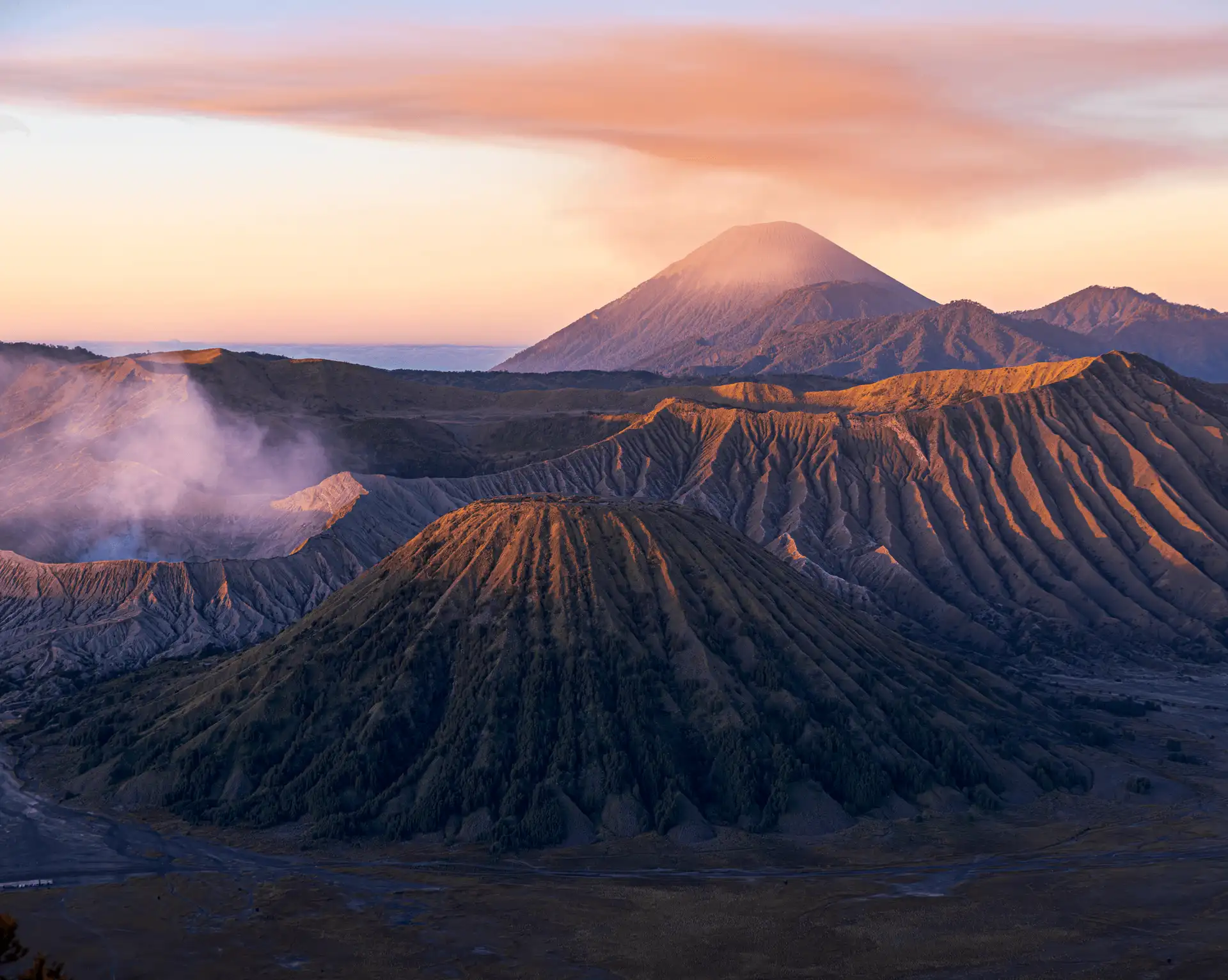
To see the **Mount Bromo sunrise**, you leave your base village in the middle of the night by jeep and drive 30 to 45 minutes up to the **Penanjakan** viewpoint, at about 2,770 m. Expect 5-10°C and a crowd at the main platform. After first light, the jeep drops to the Sea of Sand, and a 20-minute walk plus about 250 steps takes you to the crater rim at 2,329 m. It is dark, and colder than you ever imagined Indonesia could be. Somewhere in the highlands of East Java, a red jeep starts up. Its destination is the Bromo volcano, one of the most striking landscapes in Southeast Asia. If you are planning a [trip to Java](https://www.shantitravel.com/en/travel-indonesia), this is the morning travellers talk about for years. A short night, a biting cold, bumpy tracks, and then the first rays set the Tengger caldera ablaze and trace the shapes of Bromo, Batok and Semeru. This guide follows the morning in order, from the jeep to the crater rim, and ends with a waterfall for the way back.
Only a short list of countries can enter Indonesia without a visa. If yours isn't on it, the visa on arrival takes a few minutes online. Here's who qualifies, what it costs and what to fill in before you fly.
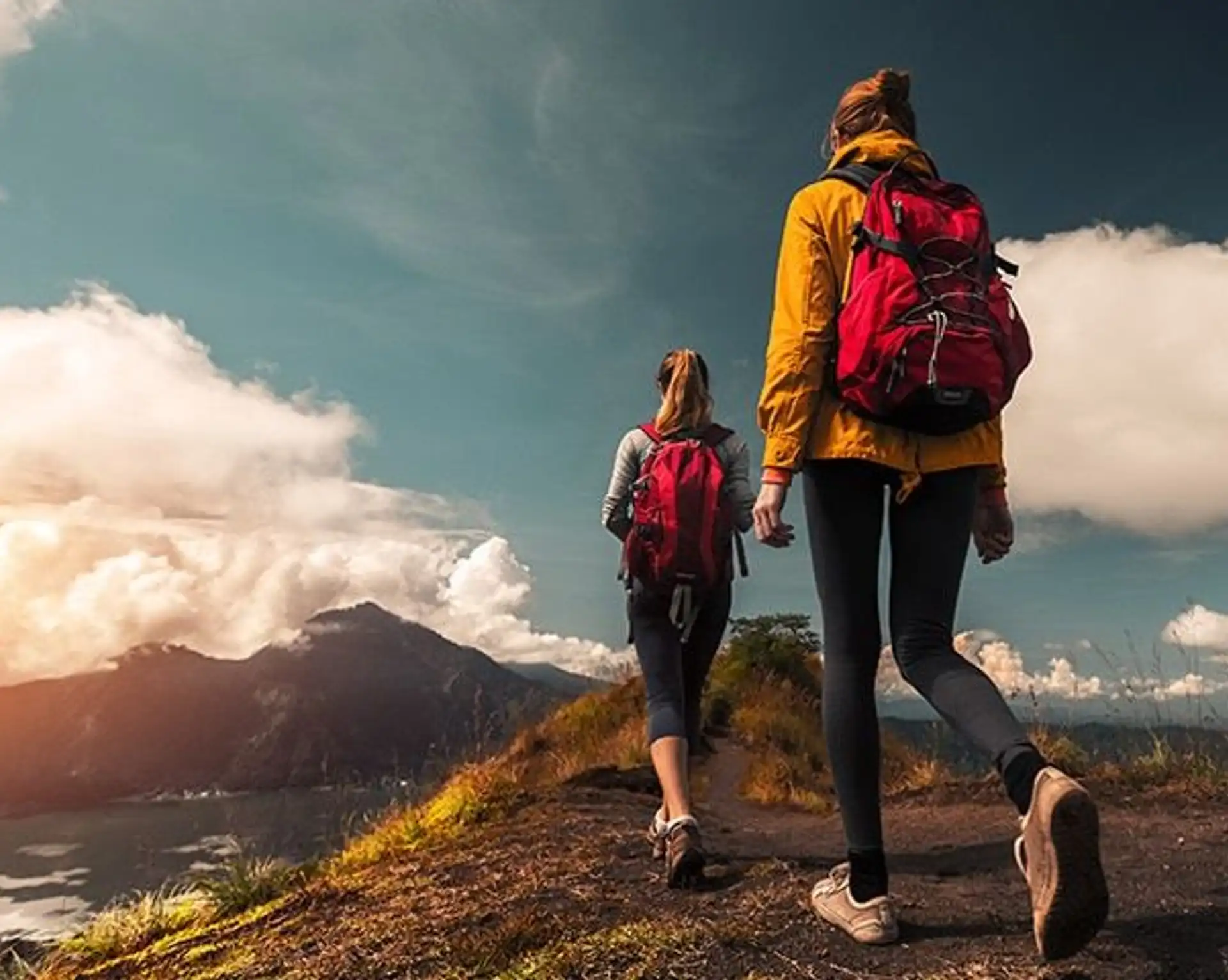
Travelling in a group means sharing the unforgettable moments of an authentic journey, building meaningful connections, and exploring the wonders of Asia with complete peace of mind. Discover why this shared adventure continues to inspire more and more travellers. Travelling in a group means sharing the unforgettable moments of an authentic journey, building meaningful connections, and exploring the wonders of Asia with complete peace of mind. Discover why this shared adventure continues to inspire more and more travellers.
Subscribe and receive our travel inspirations and practical advice twice a month.

Wanting to share your trip with a group?