Your expert on destination Bhutan
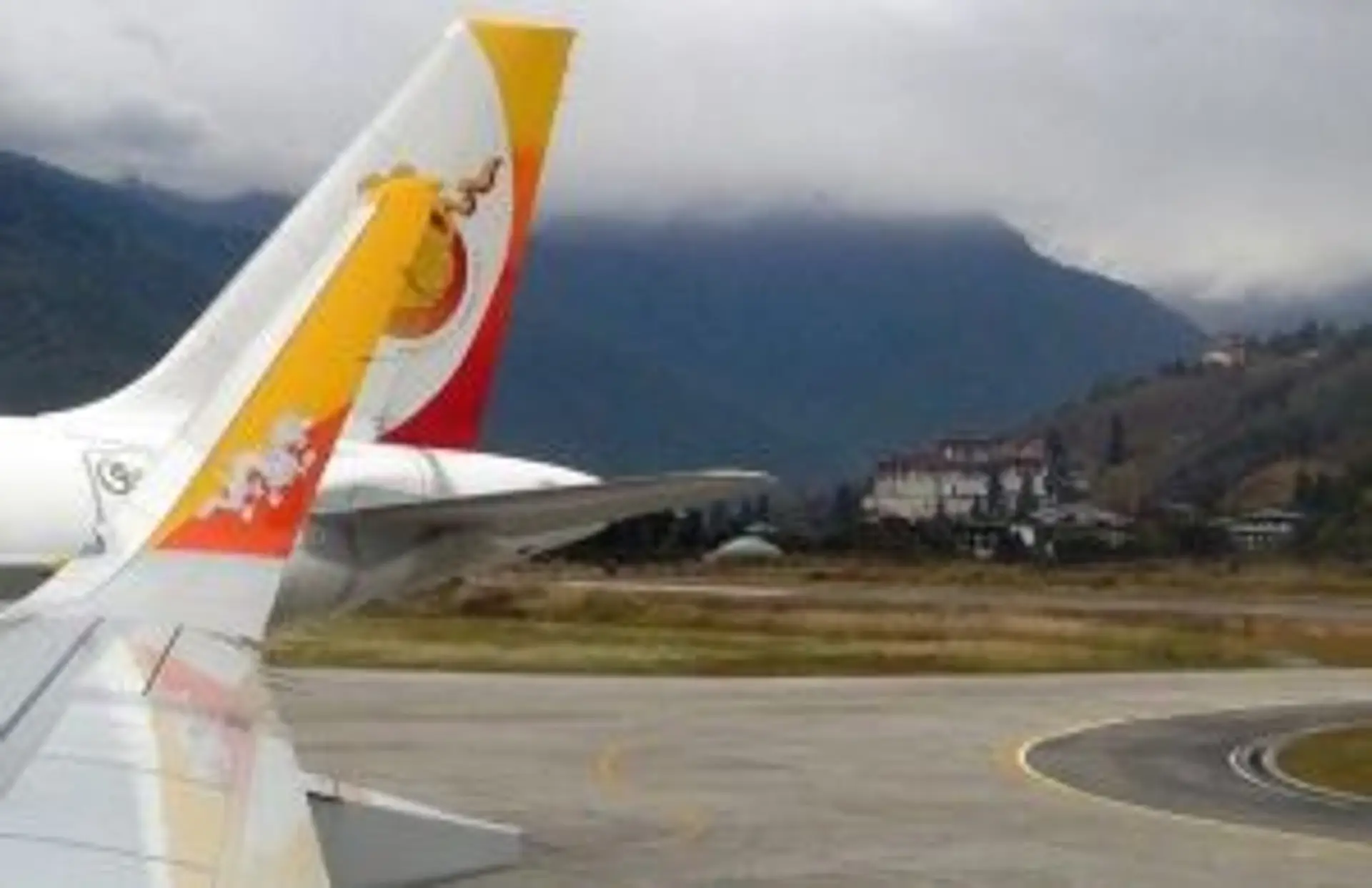
To get to Bhutan, most travellers fly into Paro, the country's only international airport, on Drukair or Bhutan Airlines. You also need a visa, which costs US$40, and you pay a daily Sustainable Development Fee of US$100 per adult as of November 2026.
This guide explains how to get to Bhutan, from the flights and land entry points to the visa and the fee, and then how you move around once you are inside. It covers the whole journey: arrival, paperwork and the road. For the wider picture, see our Bhutan travel guide.
Fly into Paro. It is the simplest route and the one nearly every visitor takes. Two airlines serve it: Drukair (Royal Bhutan Airlines) and Bhutan Airlines. The alternative is the land route through southern India, which suits travellers who want to combine Bhutan with Sikkim or Assam.
Whichever way you arrive, the trip is booked through an approved agency. Bhutan does not allow independent travel, so the visa, the guide and the vehicle are arranged before you leave home.
Not sure which route suits your trip? Our Bhutan experts can map it for you.
Paro is not a routine landing. The runway sits in a narrow valley ringed by peaks that reach 5,500 m, and only a select group of pilots is authorized to land there. On a clear day the approach gives you views of Jomolhari, Kangchenjunga and even Everest.
Only two airlines fly in. Drukair, the national carrier, publishes its timetable on the Drukair flight schedule page. Bhutan Airlines is the second carrier.
Here are the departure points that connect to Paro:
| Departure city | Carrier | Frequency |
|---|---|---|
| Bangkok, Thailand | Drukair | Daily |
| Delhi, India | Drukair | Regular |
| Kolkata, India | Drukair | Regular |
| Bagdogra, India | Drukair | Regular |
| Gaya, India | Drukair | Regular |
| Guwahati, India | Drukair | Regular |
| Kathmandu, Nepal | Drukair | See the schedule |
| Dhaka, Bangladesh | Drukair | Regular |
| Singapore | Drukair | Regular |
| Dubai, UAE | Drukair | Twice a week |
Schedules shift by season, so check the airline's own page before you book. Kathmandu is the connection many travellers use, which is why it appears so often in itineraries that pair Nepal with Bhutan.
One newer route leaves from the south. From 12 December 2025, Drukair flies Gelephu to Kolkata twice a week, on Mondays and Fridays, as of November 2026. Confirm the days with Drukair before you plan around it.
You connect through a regional hub on the way from the US. Kathmandu and Delhi are the two most common choices. Bangkok, Singapore and Dubai also work, since each has a Paro flight of its own.
Plan the connection first, because it decides the rest. Book the long-haul leg to your hub, then continue to Paro on Drukair or Bhutan Airlines. The US$40 visa and the daily fee below apply to US passport holders as they do to most foreign visitors, and the US State Department's Bhutan information on travel.state.gov lists both amounts.
You can also cross from India. Three entry points sit along the southern border: Phuentsholing, Samdrup Jongkhar and Gelephu.
Phuentsholing is the busiest. It lies about 170 km from Thimphu, roughly 6 hours by road. Gelephu is about 250 km from Thimphu, around 10 hours. Both are long days, so most people treat the drive as part of the journey rather than a transfer to get through.
The land route works well if you want to pair Bhutan with another region. Entering by road lets you combine the country with Sikkim or Assam, which is how our Sikkim and Bhutan trip is built. You also see the southern regions, which flight arrivals skip entirely.
One rule applies on every route: the trip must be arranged through a licensed operator before you cross. Do not turn up at the border and expect to sort it out there.
Every foreign visitor pays two things to the state: a visa fee, and the Sustainable Development Fee (SDF). The first is a one-off payment, and the second is charged each night you stay.
The visa application costs US$40, one-off and non-refundable, according to the official Bhutan tourism site. Your approved agency applies for it in advance. The SDF is US$100 per adult per night as of November 2026, per the US State Department's travel.state.gov, and 2026 listings agree.
| Item | Amount | Notes |
|---|---|---|
| Visa application | US$40 | One-off, non-refundable |
| SDF, adults | US$100 per night | As of November 2026 |
| SDF, children 6 to under 12 | US$50 per night | Half the adult rate |
| SDF, children under 6 | No fee | |
| SDF, Indian nationals | INR 1,200 per night | As of September 2026 |
The adult rate is valid until 31 August 2027.
A worked example: six nights cost US$600 in SDF plus the US$40 visa, so US$640 before flights and tours.
The fee sits inside the daily package, which the Bhutanese system builds around full-board accommodation, transport, an English-speaking guide and the SDF itself. Because the package is compulsory, there is no way to travel on your own. Beyond Paro and Thimphu, a guide is required in any case, and an operator is the practical way to arrange it. The official visitor page explains the rest of the rules for visitors.
We handle the visa, the daily package and the timing of your Paro flights for you: tell us your dates.
Once you are in, almost everything happens on the road. Bhutan's roads are improving gradually, but they are still winding and narrow, often cut into the mountainside. The National Highway is the main artery linking east and west. A modernisation programme is under way, and works can slow traffic or close sections for a while, especially in the east.
Expect long journey times for short distances. Terrain sets the pace, not the kilometres. You will cross several passes, some above 3,800 m, such as Chele La. Night driving is best avoided, and the rainy season brings slippery surfaces and a higher risk of landslides.
Public buses link the main towns. They are basic and not very comfortable. A private Toyota Coaster is the more pleasant option, though it costs more and has to be booked in advance.
Domestic flights exist but are very limited. They connect only a few towns, Paro, Bumthang and Trashigang, and weather decides whether they fly.
Under Bhutanese law, every foreign traveller goes through an agency and gets a vehicle with a driver for the whole tour. Driving yourself is not permitted.
Drivers handle these roads well. Conversation is mostly in basic English, so your guide steps in whenever a longer exchange is needed. On adventure tours, the driver stays on call for transfers linked to trekking and walking days.
Spring and autumn are the high seasons, and seats on Paro flights are limited then. If your dates fall in either window, book the flights early. Our guide to the best time to visit Bhutan covers the seasons in more detail.
Getting in is the logistical part of Bhutan. The rest is easier when someone who lives there plans it. Our local experts design tailor-made Bhutan trips, handle the visa and fee, and fit the flights and the roads into a route that makes sense. Create your tailor-made Bhutan trip with a local expert.
Mountain terrain and weather can change flight conditions at short notice. Leave a wide margin between your Paro flight and any onward international connection, rather than booking a tight same-day link. Check the latest timings with the airline before you travel.
Yes, both are booked through an approved agency with a professional guide. Treks range from the 3-day Druk Path between Paro and Thimphu to Jomolhari, while the Snowman Trek is for experienced walkers; porters use yaks or mules depending on altitude. Cycling routes follow the main road west to east over passes above 3,000 m, with 70 to 115 km a day, sometimes more than 2,000 m of climbing, and a support vehicle. A Bhutan marathon is held every March.
Rarely. Specialised programmes are few, but some agencies can arrange rides on request, such as the ascent to Taktsang (Tiger's Nest) in Paro. Mules are used mainly to carry loads on treks, and occasionally to relieve a tired child. If riding appeals, tell your organiser in advance so it can be built into a tailor-made itinerary.
Subscribe and receive our travel inspirations and practical advice twice a month.
Wanting to share your trip with a group?