Is Delhi worth visiting?
Yes: the best things to do in Delhi take at least two days, and the city repays a third. Its poor reputation comes from the way travellers first meet India, somewhere between fascination and apprehension, and Delhi is where that meeting happens, usually jet-lagged. Give it a proper look and each neighbourhood turns out to have its own identity and rhythm.
The old and new halves of the city make sense once you know the history. The move of the capital from Calcutta was decided in 1911, and the new city was inaugurated as capital in 1931. That is why spice-scented lanes and Mughal fortresses sit a short ride from wide colonial avenues and lawns.
The sections below follow four areas:
- Old Delhi: lanes, markets, a great mosque and the Red Fort
- Central and New Delhi: tombs, avenues, gardens and temples
- South Delhi: Qutub Minar, Hauz Khas and ruined forts
- Evenings and experiences: food, puppets, shopping and shows
Things to do in Old Delhi
Old Delhi is a living labyrinth. The smell of spices reaches you before the first corner, and the noise follows. Plan a morning here, wear shoes you don't mind getting dusty, and go slowly.
Chandni Chowk and the spice market
Walk the lanes of Chandni Chowk with no fixed route. Stop for a glass of chai at a stall, watch porters stack sacks of chillies and turmeric, then push on into the spice market, where the air makes you cough and smile at once. It is crowded, loud and tiring, and it is the best introduction to the city. Keep your bag in front of you, carry small notes for the stalls, and let yourself get a little lost: every lane ends somewhere interesting, and a rickshaw or the Metro is never far when you've had enough. Late morning is the busiest stretch, so go early if crowds wear you down.
Jama Masjid
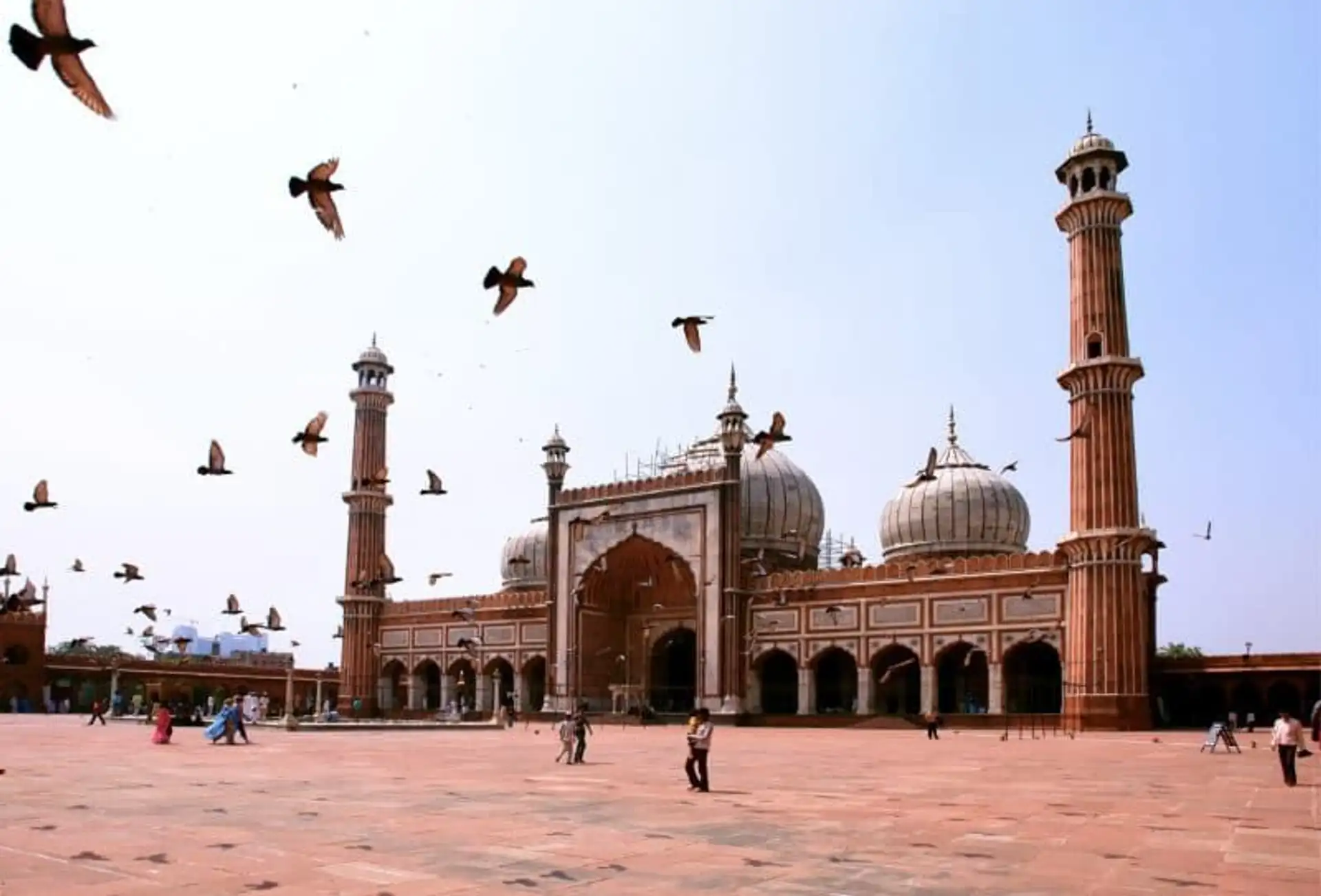
The mosque's minarets are the reason to come: climb for a view over the rooftops and the haze of Old Delhi. Dress modestly, cover shoulders and knees, and expect to take your shoes off. The courtyard is wide and open, which makes it a good place to sit for a few minutes after the press of Chandni Chowk, and the rooftop view explains how the lanes below are laid out.
Red Fort
The Red Fort impresses for its imperial history, and its gardens are a real breather, with shade under the trees in the middle of the urban tumult. Give it a couple of hours: the fort is big, the walls throw long shadows, and the most pleasant stretch is the garden side, away from the entrance queues. Go as soon as it opens in summer, before the heat builds. Foreigners pay around Rs 550 online (about €5.50) as of September 2026. It is open 9:30 AM to 4:30 PM and closed on Mondays, according to Delhi Tourism (October 2025).
Old Delhi at dawn
The lanes are quietest early. A morning ride through them by bicycle shows you the city waking up, which is hard to get on foot at midday. Read more in our piece on cycling through Old Delhi.
Prefer a local guide for the lanes? Our India experts can plan it.
Things to do in central and New Delhi
The contrast hits as soon as you cross into New Delhi: wide avenues, colonial monuments, lawns and big trees. Distances are longer here, so group the stops by taxi or Metro.
Humayun's Tomb
Humayun's Tomb is the calmest major monument in Delhi, a Mughal mausoleum in formal gardens with plenty of room to wander. The foreigner ticket is Rs 600 (about €6) as of February 2026, and it is open daily from sunrise to sunset, per the official Delhi Tourism page. Come late afternoon when the sandstone warms up and the light turns golden. The gardens are laid out in a strict geometric pattern, and the paths make for an easy, shaded walk. Most visitors stay an hour or two, though photographers and history readers can easily stay longer. It is one of the best places in Delhi to understand how Mughal architecture shaped what came later.
India Gate and Rajpath
Rajpath leads in a straight line to India Gate, an emblematic war memorial and a favourite place for Indian families to stroll in the evening. Ice cream sellers, balloons and picnics: it is more fun for the people-watching than the monument. The avenue is wide, flat and lined with lawns, so it suits a slow stroll after the heat of the day, and it gives you a sense of the scale of the planned capital that the older lanes never could.
Connaught Place
Connaught Place, the white colonnaded circle at the centre, is the nerve centre of the modern city. Use it for a meal, a cafe or a shopping break between sights rather than as a destination.
Gurudwara Bangla Sahib
This Sikh gurudwara is a spiritual break from the traffic. Cover your head, remove your shoes and sit by the pool for a while. The atmosphere is calm, and visitors of all faiths are welcome.
Jantar Mantar
Jantar Mantar is an 18th-century astronomical observatory, a set of oversized stone instruments for tracking the sun and stars. Short but surprising, and easy to pair with Connaught Place.
Gandhi Smriti
Gandhi Smriti retraces the life of the Mahatma through an exhibition. Allow an hour; it is moving without being heavy.
Lodhi Garden
Lodhi Garden is where Delhi goes jogging. Old tombs sit among lawns and tall trees, which makes it the best place for a slow hour, especially after a hot morning of monuments.
Lotus Temple
The Bahai House of Worship, known as the Lotus Temple, is open to all faiths. Its white petal shape is more striking in person than in photos, and the quiet inside is the point. Plan to sit a while rather than tick it off; the contrast with the traffic outside is part of the visit, and it makes a good last stop of a long day.
When it's hot or raining
Delhi's museums are a sensible plan B when the sun is fierce or the monsoon arrives: air conditioning and a few hours of context before heading back out.
Places to visit in South Delhi
South Delhi is greener and calmer, and it holds some of the city's oldest stones. This is the area for a long afternoon that ends in the evening.
Qutub Minar
The Qutub Minar is a 72.5 m minaret, built from the stones of an older fort and Hindu temples. The complex is a good place to slow down, and it is worth walking the whole site rather than just photographing the tower. The surrounding complex is airy, full of arches and carved stone, with parakeets overhead and cool shade between the ruins. Foreigner tickets run Rs 550 to 600 (about €5.50 to 6) as of November 2026, depending on how you pay. Official hours are sunrise to 8 PM, but sources differ, so check the official Delhi Tourism page on the day.
Hauz Khas Village
Hauz Khas Village is a trendy urban village of bars and art galleries. It comes alive in the evening, so save it for after dark rather than midday. Come for a drink and a wander among the galleries, and book a table ahead if you want a seat with a view on a weekend. Midday here is quiet and a little flat, which is exactly why the timing matters.
Tughlakabad
The ruined fort of Tughlakabad is atmospheric, with big walls and broken corridors and fewer visitors than the main monuments. Bring water and good shoes; shade is scarce. The ruins are large and the ground uneven, so go with a driver or guide who knows the way in, and don't count on finding a cafe nearby. Late afternoon, when the walls turn orange, is the kindest time.
Offbeat things to do in Delhi
Most lists stop at the famous monuments. These add texture:
- Akshardham: a vast modern temple east of the Yamuna river, with a light and water show.
- Jhandewalan Hanuman Temple: home to a 34 m statue of Hanuman.
- Street art in Lodhi Colony: murals on residential walls, easy to combine with Lodhi Garden.
- Baba Kharak Singh Marg: a street of handicraft shops, good for browsing crafts in one place.
Experiences and evenings in Delhi
Cycle Old Delhi at dawn
Pre-breakfast riding through the lanes, past waking markets and tea stalls. See the Old Delhi bicycle experience for how it works.
A Delhi food walk
Delhi's street food is a reason to come in itself: fried snacks, sweet jalebis, hot parathas, cold lassis, all within a few streets. A guided food walk takes the guesswork out of what to order. The Delhi section of our guide to North Indian food is a good place to start.
An evening at House of Puppet
For a deep dive into traditional Indian arts, spend an evening at House of Puppet in Kathputli Colony. Details are in House of Puppet, a zest of Rajasthan in Delhi.
Kingdom of Dreams
Kingdom of Dreams offers big, loud shows: a spectacle rather than a quiet cultural evening.
Delhi shops by neighbourhood: Connaught Place, Paharganj, Dilli Haat and Sarojini Nagar each have their own side. For a Delhi-style touch, do the circuit in a vintage Ambassador.
Delhi sightseeing in 2 to 3 days
Three days is enough to see the main areas without rushing, and the order below keeps travel time short: each day stays inside one part of the city, with a long break in the middle for lunch and the worst of the heat. Split the city by area to avoid crisscrossing traffic: Old Delhi, then New Delhi, then the south.
| Day | Area | Stops |
|---|
| Day 1 | Old Delhi | Chandni Chowk, spice market, Jama Masjid, Red Fort |
| Day 2 | New and central Delhi | Humayun's Tomb, India Gate, Connaught Place, Bangla Sahib, Lodhi Garden |
| Day 3 | South Delhi, offbeat and evening | Qutub Minar, Tughlakabad, Hauz Khas, Akshardham or a puppet show |
With only two days, merge days 2 and 3 and drop the offbeat stops. For more Mughal-era sites across the region, see our top 10 monuments of North India.
Planning more than Delhi? Add Delhi to a longer India route with a local expert.
Fees, hours and tips at a glance
| Monument | Foreigner fee | Days and hours | As of |
|---|
| Red Fort | Around Rs 550 online | Closed Mondays, 9:30 AM to 4:30 PM | Sept 2026 |
| Humayun's Tomb | Rs 600 | Daily, sunrise to sunset | Feb 2026 |
| Qutub Minar | Rs 550 to 600 | Sunrise to 8 PM (check on the day) | Nov 2026 |
Fees change, so check the official Delhi Tourism pages before you go.
Let a local expert build your Delhi
Delhi is easier with someone who lives there. Tell us what you want to see and a local expert will build the trip around it, whether Delhi is your first stop or part of a longer route across India.