Your expert on destination Japan
Discovering the minorities and ethnic groups in Japan means immersing yourself in a cultural mosaic often overlooked behind the image of a homogeneous country. With over 20 years of exploration and on-the-ground experience, Shanti Travel offers insights into the diverse reality of the archipelago through its history, struggles, traditions, and the contemporary challenges faced by its various populations.
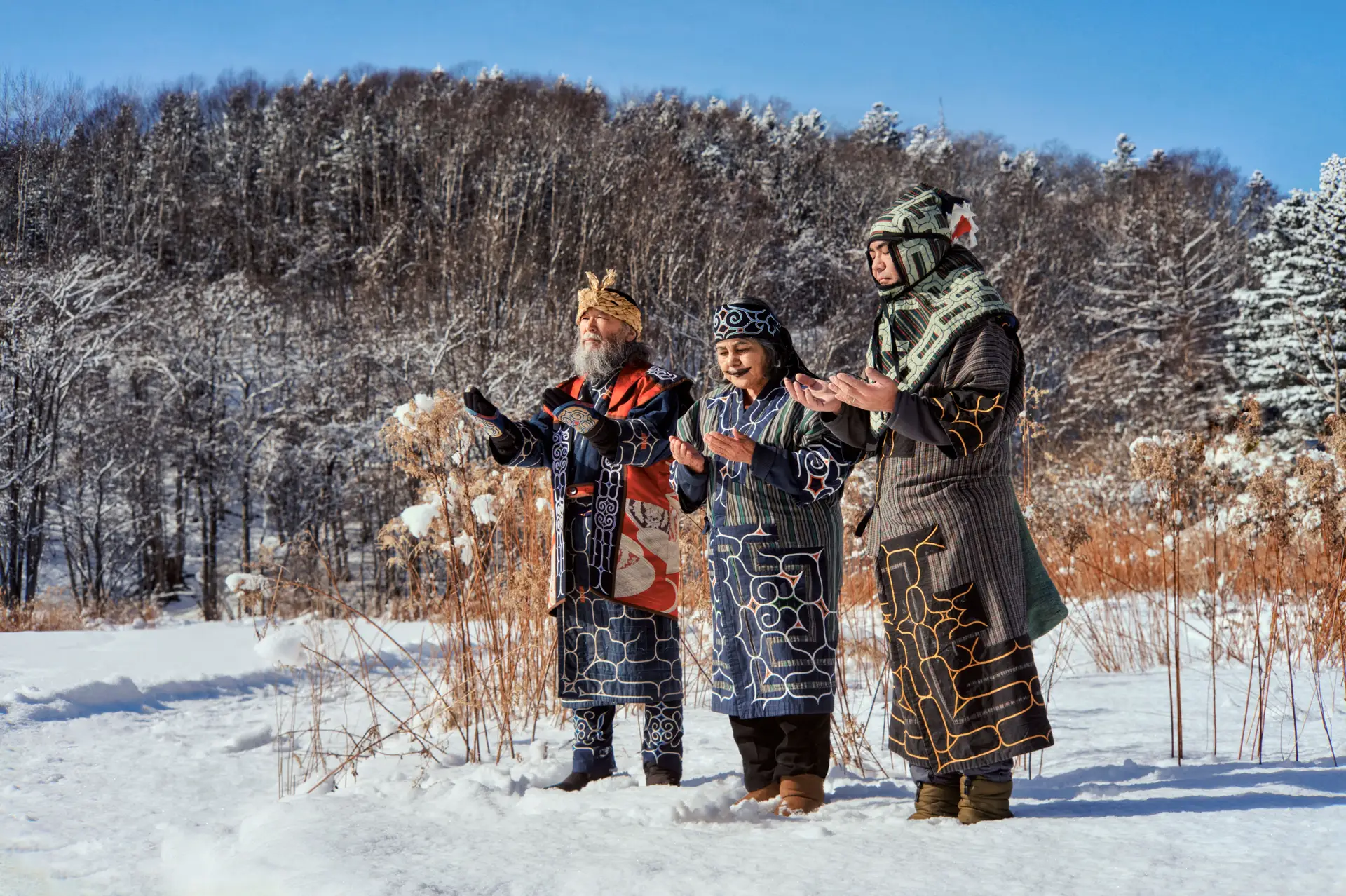
The Ainu are an indigenous people of northern Japan, primarily found in Hokkaido and historically on the Kuril Islands and Sakhalin. Their origins date back over 1,000 years, having arrived from North Asia via the Russian peninsulas. According to Japanese legends , they were the first inhabitants of the archipelago, possessing a physical appearance distinct from modern Japanese: full hair and beards for the men, ritual tattoos for the women, and ornate traditional clothing.
Ainu culture, based on animism, values nature and spirits (kamuy). Ceremonies like the Iomante (bear ceremony) testify to the depth of this spiritual connection. Traditional crafts—wood carving, embroidery, basketry—are the subject of preservation efforts, as is their language, the only linguistic isolate, which is now highly endangered (approximately 300 speakers).
After centuries of marginalization and assimilation policies, the Japanese state officially recognized the Ainu as an indigenous people in 2019, paving the way for the appreciation of their heritage through initiatives such as Upopoy, a museum and national park in Hokkaido. Nevertheless, this legal recognition remains recent: many Ainu living outside Hokkaido remain invisible, and the issue of true equality—access to healthcare, education, employment, and the fight against discrimination—remains crucial. Traveling to northern Japan, therefore, also means opening oneself to this strong cultural identity, a blend of preserving traditions and expressing them in a modern way.
The Yamato people constitute the majority of the Japanese population and have shaped the national identity for over two millennia. Originating from the Nara region (the former Yamato province), this group gradually rose to prominence, establishing a centralized society in the 3rd and 4th centuries. National myths glorify the Yamato and construct the image of Japanese homogeneity: the concept of "yamato-damashii" (the Japanese spirit) expresses the values of group attachment, loyalty, and social harmony.
From a historical perspective, this unity was built by assimilating or marginalizing other island peoples, notably the Ainu in the north and the Ryukyus in the south. During the Meiji era, centralization and assimilation policies accentuated the cultural and administrative dominance of the Yamato, contributing to the invisibility of other ethnic identities. Even today, this narrative of unity, although tempered by contemporary realities, remains deeply rooted in the Japanese collective imagination, even as minorities with their own distinct traditions persist and assert themselves.
The Burakumin illustrate the social complexity of Japan: they do not constitute an ethnic minority, but a group historically formed from trades considered "impure" during the feudal era (butchers, tanners, gravediggers, executioners). Isolated in specific neighborhoods (buraku), they have long suffered from institutionalized exclusion.
Despite the abolition of the caste system during the Meiji era, the stigma persists: discrimination in hiring and housing, obstacles to marriage, and the existence of clandestine registers listing families from these neighborhoods. The Burakumin, physically indistinguishable from the rest of the population, sometimes resort to "passing" to conceal their origins. The struggle for dignity and recognition has given rise to powerful organizations such as the Buraku Liberation League. The state has implemented a rehabilitation policy (dōwa), and since 2016, a law has officially condemned discrimination in this regard, although integration remains uneven. The Burakumin thus serve as a reminder that the homogeneity promoted by Japan remains a social construct and not a lived reality for all.
The Ryukyu people are native to the Ryukyu Islands, of which Okinawa is the most famous. Heirs to an independent kingdom from the 15th to the 19th century, they maintain linguistic (Ryukyu languages, now seriously threatened), religious (ancestral worship, shamanic practices), culinary and artistic particularities that distinguish them from Yamato Japan.
The annexation of the kingdom by the Japanese Empire in 1879 accelerated a policy of assimilation: the teaching of Japanese and the administrative suppression of local distinctions. Even today, the Japanese state refuses to officially recognize the Ryukyu people as a distinct minority, assimilating them into the majority group, a source of tension. After World War II, the region was under American administration until 1972; the establishment of US military bases, imposed without genuine consultation, solidified a feeling of dispossession and mistrust towards Tokyo.
The preservation of traditions and language, the fight against cultural standardization, and the impact of the military presence shape the daily lives of the Ryukyu people. Their situation highlights the tensions between asserting their identity, policies of assimilation, and institutional recognition in Japan.
While various immigrant communities exist in Japan, the largest are the Koreans (Zainichi) , heirs to a painful history linked to the Japanese colonization of Korea (1910-1945), and the Chinese , now the largest foreign community in terms of numbers. These populations, primarily located in major cities, still face discrimination in daily life (employment, housing, citizenship), and official recognition of their specific status remains limited. However, they enrich Japanese urban culture through their cuisine, economic dynamism, music, and cultural expressions.
Traveling to Japan with Shanti Travel will introduce you to a society that, far from being monolithic, weaves together a plurality of histories, languages, and traditions. Japanese and foreign minorities bear witness to the enduring presence of unique cultures, sometimes marginalized, often striving for recognition and preservation. Meeting them and understanding their contemporary challenges will enrich your experience of Japan with a human and historical depth rarely accessible without an expert guide.
To further explore Japanese diversity, also consult the cultural differences in Japan and plan a tailor-made stay at the heart of the country's identities.
Subscribe and receive our travel inspirations and practical advice twice a month.
Wanting to share your trip with a group?








![Alignement de maisons de pêcheurs traditionnelles funaya au bord de l'eau dans le village de pêcheurs d'Ine au Japon[cite: 10].](https://dozjp40rj04ea.cloudfront.net/eyJidWNrZXQiOiJzaGFudGktc3RyYXBpLXVwbG9hZHMiLCJrZXkiOiJKYXBvbl9JbmVfVmlsbGFnZV8wMDk0MjE5MTYwLmpwZyIsImVkaXRzIjp7InJlc2l6ZSI6eyJmaXQiOiJjb3ZlciIsIndpZHRoIjoyNTZ9LCJ0b0Zvcm1hdCI6IndlYnAiLCJ3ZWJwIjp7InF1YWxpdHkiOjU1fX19)